

Furnace & gas safety: carbon monoxide, gas leaks and who to call
Quick answer: If you smell gas, leave the house now and call Enbridge Gas at 1-866-763-5427 or 911 from outside. If your carbon monoxide alarm goes off or anyone feels sick, dizzy or has a headache, get everyone outside and call 911.
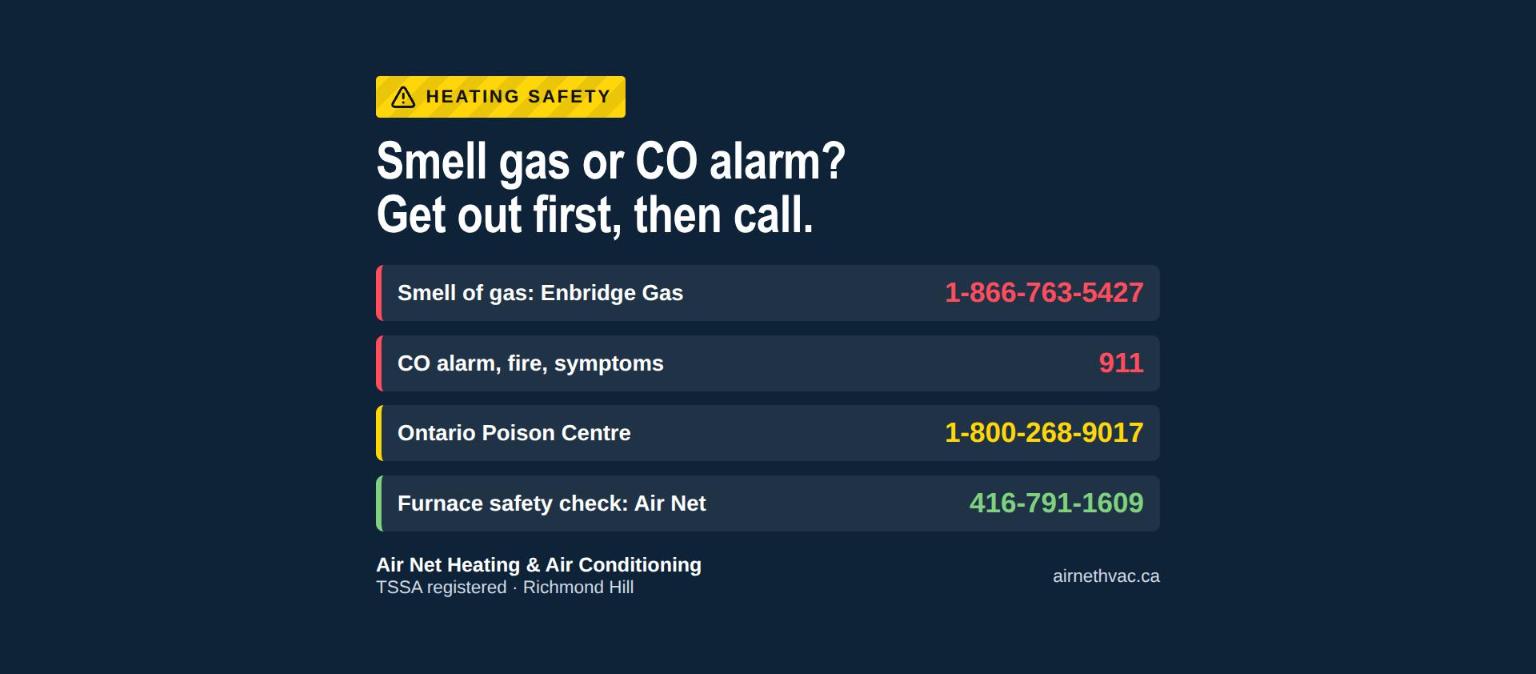
CAUTION: Air Net is not an emergency service. For a gas smell, a CO alarm or a fire, call 911 or Enbridge Gas first. Once your home has been made safe, call us at 416-791-1609 (8am to 8pm, 7 days a week) to inspect and repair your furnace.
Who to call: heating safety phone numbers in Richmond Hill and Ontario
Save these numbers in your phone. Always call from outside if you smell gas or your CO alarm is sounding.
Fire, police, ambulance. Call from outside if your CO alarm sounds, someone has CO symptoms, or there is a fire.
Smell of gas or a damaged gas line. 24 hours. Leave the house first, then call.
Advice if someone may have been exposed to carbon monoxide. 24 hours.
Ontario’s fuel safety regulator. Gas appliance safety questions, or check that a contractor is registered.
Furnace safety checks, CO testing and repairs once your home is safe. 8am to 8pm, 7 days a week.
What should I do if I smell natural gas?
Natural gas has a smell added to it, like rotten eggs, so you can notice a leak.
- Stop what you are doing. Do not turn lights, switches, appliances or the thermostat on or off, and do not use your phone inside.
- Leave the house right away with everyone, including pets. Leave the door open behind you if you can do it without delay.
- Once you are outside and away from the house, call Enbridge Gas at 1-866-763-5427 (24 hours) or 911.
- Do not go back in until Enbridge or the fire department says it is safe.
Do not look for the leak or try to fix it yourself. After Enbridge has made it safe, call a TSSA-registered gas technician to repair the appliance.
What are the signs of carbon monoxide (CO) poisoning?
Carbon monoxide is a gas you cannot see, smell or taste. It comes from fuel-burning appliances like a furnace, fireplace, gas stove or water heater when they do not burn or vent properly.
Symptoms feel like the flu, but without a fever: headache, nausea, dizziness, confusion and drowsiness. High levels can cause loss of consciousness and death. A clue is when everyone in the house feels sick at the same time and feels better after leaving.
If your CO alarm goes off or anyone has symptoms: get everyone outside to fresh air right away, then call 911 from outside. If someone was exposed, the Ontario Poison Centre is available 24 hours at 1-800-268-9017.
What is CO spillage or backdrafting from a furnace?
Spillage (also called backdrafting) is when exhaust gases from your furnace or water heater come back into the house instead of going up the chimney or out the vent. The exhaust contains carbon monoxide.
Warning signs:
- A smell of exhaust or a stuffy, stale smell near the furnace or water heater
- Black soot or rust around the vent pipe, draft hood or furnace door
- Heavy condensation on windows
- Melted or scorched plastic or wires near the water heater draft hood
- A CO alarm that goes off more than once
Common causes are a blocked or disconnected vent pipe, a blocked chimney, or strong exhaust fans pulling air out of a tight house. A licensed technician can test for spillage with a combustion analyzer.
What is a cracked heat exchanger, and is it dangerous?
The heat exchanger is the metal part inside a gas furnace that keeps the flame and exhaust separate from the air that blows through your home. Over many years of heating and cooling, it can crack.
A crack can let carbon monoxide mix into the air going to your rooms. Signs include a flame that dances or changes when the blower starts, soot inside the furnace, a CO alarm, or the furnace shutting off on safety.
If a technician finds a cracked heat exchanger, the furnace should be shut off and either the heat exchanger or the furnace replaced. It should not be run “until spring”.
What colour should my furnace flame be?
A healthy gas flame is steady and mostly blue.
A yellow, orange or lazy, flickering flame, or soot around the burners, means the gas is not burning cleanly and can produce carbon monoxide. Have a technician check and clean the burners and test combustion.
Where do I need carbon monoxide and smoke alarms in Ontario?
Ontario law requires a CO alarm next to each sleeping area in homes with a fuel-burning appliance (like a gas furnace), a fireplace or an attached garage. The province also recommends one on every storey. Ontario also requires a working smoke alarm on every storey and outside sleeping areas.
- Test both alarms every month with the test button.
- Replace batteries every year.
- Replace the alarm by the date the manufacturer gives. Most CO alarms last 7 to 10 years, and smoke alarms 10 years.
- Learn the difference between the CO alarm sound and the smoke alarm sound.
Why should I keep furnace vents and intakes clear?
High-efficiency furnaces have two white plastic pipes on the outside wall or roof: one brings air in and one sends exhaust out. If snow, ice, leaves or a bird nest blocks them, the furnace can shut down or exhaust can come back inside.
- After a snowfall, check the pipes and clear snow from around them by hand.
- Keep at least 30 cm (1 foot) of space around them, and do not stack snow or firewood there.
- Keep chimneys, the dryer vent and air returns inside the house clear too.
What should not be stored near my furnace?
Keep the furnace room clear. Do not store paint, gasoline, propane cylinders, solvents, cleaning chemicals, laundry or boxes near the furnace or water heater. Leave space around it so it can get the air it needs to burn safely, and keep the furnace door closed.
Are space heaters, generators and barbecues safe indoors?
- Keep electric space heaters at least 1 metre (3 feet) from furniture, curtains and bedding, plug them straight into the wall, and turn them off when you leave the room or go to sleep.
- Never use a barbecue, propane heater, camp stove or generator inside the house, garage or basement, even with a door open. They make deadly levels of carbon monoxide.
- Never use a gas oven or stove to heat your home.
- Never warm up a car in an attached garage, even with the garage door open.
How often should my furnace be safety-checked?
Once a year, ideally in the fall before the cold weather. A proper furnace tune-up includes checking the burners and flame, testing for carbon monoxide and spillage, inspecting the heat exchanger and vent pipes, and testing the safety controls. Gas appliance work in Ontario must be done by a TSSA-registered contractor with a licensed gas technician.
Book a furnace safety check in Richmond Hill
Air Net Heating & Air Conditioning is a TSSA-registered contractor. Owner Sam is a G2 gas technician with 30 years of experience. We check burners, venting, the heat exchanger and carbon monoxide levels across Richmond Hill and York Region. See also furnace maintenance and same-day furnace repair.